forum
library
tutorial
contact
Chelan PUD Explains Why
Geothermal May Fit Central Washington
by Andrew Simpson
Cashmere Valley Record, August 12, 2026
|
the film forum library tutorial contact |
|
Chelan PUD Explains Why
by Andrew Simpson
|
If geothermal resources can be developed near existing transmission infrastructure,
reliable generation could be accessed without waiting for a new transmission line
 WENATCHEE -- Chelan PUD has looked beyond hydropower before.
It studied wind roughly two decades ago, erecting meteorological towers and collecting data. It investigated biomass at five locations and has evaluated solar. More recently, it spent about two years searching for conventional hydrothermal resources.
Now, as Chelan, Douglas and Grant county PUDs prepare to drill exploratory holes for enhanced geothermal energy, Chelan PUD Managing Director of Generation and Transmission Brett Bickford says the technology offers a combination of characteristics that could make it particularly well suited to Central Washington.
It can operate around the clock, requires comparatively little surface land and could potentially be located near existing electrical infrastructure. And geological records indicate there is significant heat beneath Central Washington.
Bickford explained the utility's interest during an Aug. 11 Tri-Commission meeting of Chelan PUD, Chelan County and the Chelan-Douglas Regional Port Authority.
"The Columbia River system really doesn't support more hydro projects," Bickford said. "It's very efficiently built out now from the beginning to the end."
Chelan, Douglas and Grant PUDs have also modernized their existing hydroelectric facilities, upgrading turbines and generators to increase efficiency. But Bickford emphasized that looking for resources to complement hydro is not a new response to today's growing electricity demand.
Chelan PUD's earlier wind and biomass investigations ultimately did not produce economically attractive projects. Solar presents a different limitation. Bickford said solar generation in Chelan County has an estimated 17% utilization factor, meaning 100 megawatts of installed capacity would generate an average of about 17 megawatts.
Wind and solar can contribute to the region's power supply, but both are intermittent. Chelan PUD is also looking for resources capable of producing electricity continuously, while limiting impacts on land and water and remaining cost competitive.
Enhanced geothermal systems, or EGS, increasingly fit that description.
Unlike conventional geothermal generation, which relies on naturally occurring underground reservoirs of hot water, EGS can use wells drilled several kilometers into hot basement rock. Water circulates between injection and production wells, absorbs heat underground and returns to the surface, where that heat can be used to generate electricity.
Chelan PUD initially investigated conventional hydrothermal resources in Chelan County and worked with Energy Northwest on a broader study of Washington and neighboring states. That work found little apparent potential for utility-scale conventional geothermal generation in Washington.
 Enhanced geothermal presents a different possibility.
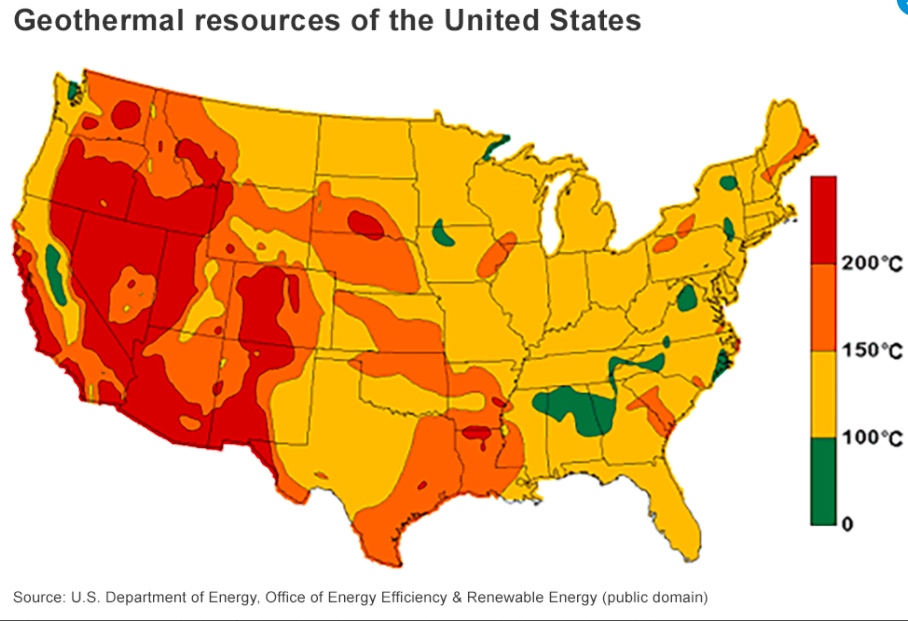
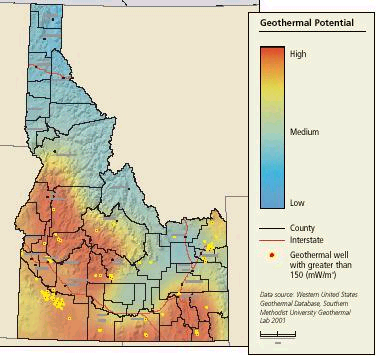
Existing geological information indicates substantial underground heat beneath Central Washington, but much of the Columbia Basin is covered by a thick layer of basalt. Bickford said it can reach 10,000 to 12,000 feet thick in the central basin, potentially making drilling there prohibitively expensive.
Toward the basin's perimeter, however, the basalt thins and the underlying basement rock becomes shallower. Chelan, Douglas and Grant PUDs plan to concentrate their initial exploration in those areas.
"We're going to explore around the perimeter where it's shallower and see whether that heat exists there as well," Bickford said.
Transmission is another factor in the PUD's interest. Large wind and solar projects have to be built where those resources are most productive, which can also require new transmission infrastructure to move the electricity to where it is needed. PUD officials said major transmission projects can take approximately 15 years to complete, adding time and expense to new generation. If geothermal resources can instead be developed near existing transmission infrastructure, the PUD could add reliable generation without waiting for a new transmission line to reach it.
Bickford said a conceptual 250-megawatt geothermal development could produce about 210 megawatts net after accounting for the facility's own energy needs. The generating plant could occupy approximately 50 acres, although its underground well field could extend across roughly 5,000 acres.
The three PUDs are now preparing permit information through the Washington Department of Natural Resources. Bickford said the first exploratory core hole could be drilled as early as late fall, with four planned by the end of 2027.
The utilities intend to share the costs and risks of exploration rather than wait for state or federal funding.
"We want to be able to solve regional energy problems," Bickford said. "We don't want to just take care of our backyard."
If drilling identifies a viable resource and suitable location, Bickford estimated development could take another four to seven years.
For Chelan PUD, geothermal is one more technology in a search that began well before current forecasts of rapidly increasing electricity demand. What distinguishes it from earlier possibilities is the combination of continuous generation, relatively limited surface impacts and geology that could make Central Washington a particularly suitable place to find out whether it works.
Related Pages:
Chelan PUD Explains Why Geothermal May Fit Central Washington by Andrew Burger, Renewable Energy World, 11/2/16
Permit Approved for Drilling on Federal Land in Idaho's Raft River Geothermal Area by Staff, Renewable Energy World, 9/20/16
US EIA Paper Shows Promise of Geothermal, Need for National Effort by Karl Gawell, Renewable Energy World, 9/16/16
learn more on topics covered in the film
see the video
read the script
learn the songs
discussion forum