a public library for anyone interested in the plight of Idaho's wild Salmon & Steelhead


|
a public library for anyone interested in the plight of Idaho's wild Salmon & Steelhead
|
|
|
Defining the Problem
US Army Corp of Engineers, February 2002 (Lower Snake River Juvenile Salmon Migration Feasibility Report / EIS)
|
|
Background
Government Accounting Office (GAO-02-612 Salmon & Steelhead Recovery Efforts)
|
|
The Federal Caucus Strategy
Conservation of Columbia Basin Fish, December 2000
|
|
Hydropower Plan
Conservation of Columbia Basin Fish, December 2000 All salmon and steelhead in the basin are affected to some extent by the hydropower system. The Strategy does not recommend removal of Snake River dams at this time. Instead, it establishes performance standards for survival of juvenile and adult fish, and a schedule for meeting those standards. Performance standards are to be met through an aggressive program of improvements that includes more flow, more spill, and continued improvements in the dams themselves to pass more fish safely. Part of the ultimate decision on dam removal will depend on the ability of the hydropower system to compensate for fish losses by improving fish survival through off-site mitigation measures. |
|||||||||||||||||||||||||||||||||||||||
|
Habitat Plan
Conservation of Columbia Basin Fish, December 2000
|
|
Harvest Plan
Conservation of Columbia Basin Fish, December 2000
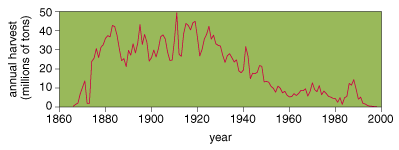
Cutting harvest immediately increases spawning escapement and can reduce near-term risks of extinction. However, reductions in harvest rates on natural stocks have been the first response to declining production and ESA listing, and now harvest rates are so low for most stocks that further reductions will not yield major benefits. Most of the harvest impacts remaining on listed fish occur in treaty-protected fisheries, which have been especially hard-hit in recent years. |
|
Hatchery Plan
Conservation of Columbia Basin Fish, December 2000
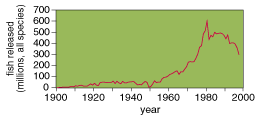
The Basinwide Salmon Recovery Strategy contains two primary hatchery initiatives. The first is to reform all existing production and mitigation hatcheries to eliminate or minimize their harm to wild fish. The second is to implement "safety net" projects using various artificial production techniques such as supplementation and captive broodstock programs on an interim basis to avoid extinction while other recovery actions take effect. |
|
Biological Considerations
Conservation of Columbia Basin Fish, December 2000
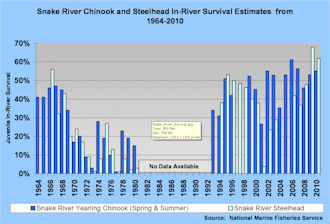
The scientific analyses examined the risks and opportunities facing all salmon and steelhead population groups (known as Evolutionarily Significant Units, or ESUs) listed under the ESA. In addition to assessing extinction risks, the analyses looked at how much improvement is needed to achieve survival and recovery. In short, the analyses give a sense of how the fish are performing now, the level at which they need to perform to avert risk, and the areas where improved performance are likely to have the greatest effect. The results are sobering. Generally, fish from the upper Columbia and Snake rivers have the furthest to go to reach recovery. Spring chinook in particular have an extremely high extinction risk in both the upper Columbia and Snake rivers. |
|
|
 see what you can learn |