the film
forum
library
tutorial
contact
|

|
Analysis of Snake River Sockeye Run Breaks Down Fish Trapped
for Broodstock, or Released in Sawtooths, or Swam Entire Journey
by Staff
Columbia Basin Bulletin, August 21, 2026
|
799 Sockeye trapped at Bonneville Hatchery were returned to Idaho's
Sawtooth Basin with 589 into Redfish Lake and 208 into Pettit Lake
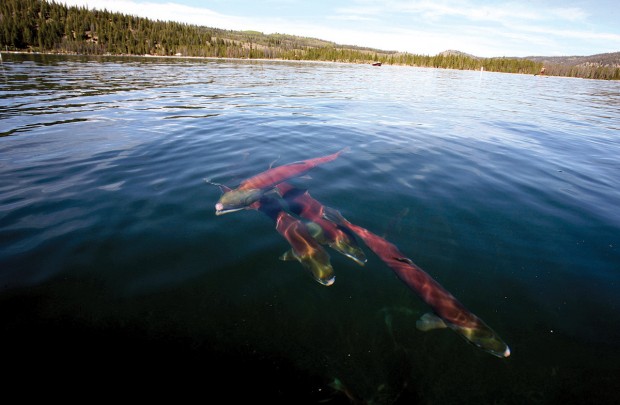 This year's run of endangered sockeye salmon into the Snake River is "effectively over" and any of the fish crossing Lower Granite Dam after July, the most upriver of the lower four Snake River dams, have almost no chance of reaching the Sawtooth Basin, said David Venditti, Principal Fisheries Research Biologist at the Idaho Department of Fish and Game. Based on an expansion of the number of PIT-tagged sockeye adults detected at Bonneville and at Lower Granite dams, Venditti is estimating that just 463 Snake River sockeye crossed Bonneville Dam and, of those, even fewer -- some 333 -- crossed Lower Granite Dam during the salmons' June and July migration (each PIT-tagged fish detected, all of hatchery-origin, represents either 18.6 or 17 fish, depending on brood year, according to Vendetti). A final count of the fish listed under the federal Endangered Species Act is due later this year.
However, that's not the entirety of the Snake River sockeye that return to the Columbia River. Sockeye were also trapped at the Bonneville Hatchery between June 30 and August 10 where 799 program sockeye were collected and returned to Idaho's Sawtooth Basin for release. According to an Aug. 13 sockeye summary by Venditti, 589 of those fish were released into Redfish Lake, 208 were released into Pettit Lake and there were two mortalities.
Of those, 15.2 percent were Age-3 fish from brood year 2023 and 84.8 percent were Age-4 fish from brood year 2022. Overall, 47.2 percent were female and 52.6 percent were male.
2026 returns of sockeye compare unfavorably to last year's count of fish at Bonneville Dam of 1,766 sockeye and 1,106 at Lower Granite. That's slightly more than the 10-year average at Lower Granite of 927 fish, but the 2024 count was a whopping 2,947 sockeye at Lower Granite. The current 10-year average is 927 fish.
This year's return, however, was anticipated to be exceptionally low after the U.S. v Oregon Technical Advisory Committee, which is charged with forecasting run sizes for Columbia River salmon and steelhead, downgraded in early July an already middling preseason sockeye forecast of 274,900 fish, by 71 percent to just 79,800 fish overall. Most of those fish will migrate into mid-Columbia tributaries, such as the Yakima, Wenatchee and Okanagan rivers, with only about one percent expected to head into the Snake River --See CBB, July 10, 2026, Substantial Downgrade Of Forecasted Columbia River Sockeye Run; Managers Tracking Progress Of ESA Snake River Sockeye Crossing Dams, Substantial Downgrade Of Forecasted Columbia River Sockeye Run; Managers Tracking Progress Of ESA Snake River Sockeye Crossing Dams -- Columbia Basin Bulletin The natural origin population abundance level to achieve delisting criterion established by NOAA's Recovery Plan for Snake River Sockeye Salmon is 2,500 Sockeye adults, of which 1,000 must be in Redfish Lake, 1,000 in Alturas Lake and 500 in Pettit Lake.
This year IDFG with the help of the Nez Perce Tribe, trapped sockeye at Lower Granite five days a week for about a month, collecting 43 sockeye beginning June 29. Trap and haul ended July 25. Two of those fish died, so 41 fish were hauled to Sweetwater Springs Hatchery near Lapwai, Idaho for temporary holding during week days, then on to Eagle Hatchery in Idaho where IDFG operates its sockeye broodstock program.
Of those 41 sockeye, Vendetti said that genetic tests of 34 of the fish found that two are wild. He expects genetic information on the remaining fish in the next two weeks. In addition, he said a final breakdown of wild or hatchery fish, including those trapped at Redfish Lake Creek or the Sawtooth Hatchery, will be completed sometime in October or November.
"The sockeye trapped at Lower Granite will most likely be used in the Eagle captive broodstock," Venditti said. "We try to incorporate successful, anadromous returns back into the broodstock whenever possible. However, we do have some discretion. For example, if two of the 41 happened to be siblings, we would likely use one in the Eagle broodstock and release one to spawn naturally. All sockeye trapped at Bonneville Hatchery have been released into Redfish and Pettit lakes."
That captive broodstock program is currently under review by NOAA Fisheries. Snake River fisheries managers want to renew the sockeye salmon hatchery broodstock program as a way to support the recovery of the ESA-listed fish and NOAA has been seeking comments on their applications that include a hatchery and genetic management plan and an environmental assessment. The period for comment closed Aug. 17.
The HGMP describes a hatchery brood stock program begun in 1991 to recover and restore the natural population of sockeye in the Snake River. The hatchery broodstock program's goal is to reestablish sockeye runs to the Sawtooth Valley while providing sport and treaty harvest opportunities.
At this date, there is little known about how many sockeye that have passed Lower Granite Dam are still on their way to the Sawtooth Basin. Vendetti said there is an instream PIT-tag detector near Challis, ID on the Salmon River, "but it seems to miss a number of sockeye every year. Beyond that, the next place they could be detected is the Redfish Lake Creek PIT-tag detector or the Sawtooth Hatchery trap.
"The first sockeye of the season swam into our Redfish Lake Creek trap on Saturday, Aug. 15)," he said.
Other details of the run included in Venditti's sockeye run summary are:
- One PIT tagged Springfield Hatchery fish went up the Columbia River and was last detected entering the Chief Joseph Hatchery ladder.
- Four run-at-large Sockeye Salmon tagged at the Bonneville Dam adult fish facility ascended the Snake River, and two crossed Lower Granite Dam.
Related Pages:
Snake River Sockeye Running Behind Forecast by Staff, Moscow-Pullman Daily News, 7/25/26
Fewer Sockeye are Returning to the Upper Columbia. Washington Closed Fishery to Protect the Salmon by Courtney Flatt, Oregon Public Broadcasting, 7/9/26
Columbia River Fish Managers Prepare for Potentially Dismal Sockeye Run by Staff, NW Fishletter, 6/30/26
Staff
Analysis of Snake River Sockeye Run Breaks Down Fish Trapped for Broodstock, or Released in Sawtooths, or Swam Entire Journey
Columbia Basin Bulletin, August 21, 2026
See what you can learn
learn more on topics covered in the film
see the video
read the script
learn the songs
discussion forum