forum
library
tutorial
contact

After Rough Patch, TMT Agrees
to Restore Injunction Spill
by K.C. Mehaffey
Clearing Up, May 29, 2026
|
the film forum library tutorial contact |
|
After Rough Patch, TMT Agrees
by K.C. Mehaffey
|
State and tribal salmon managers criticized federal agencies
for curtailing spill without following the agreed TMT process
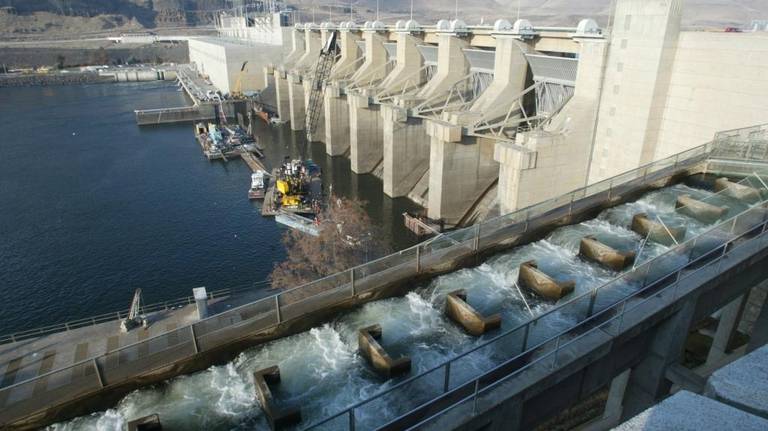 Salmon managers said they were frustrated when federal agencies curtailed spill at Lower Monumental Dam on May 26 after the Columbia River Technical Management Team (TMT) had previously agreed to monitor the delayed migration of adult spring Chinook instead (Clearing Up No. 2262).
Their concerns were heightened by a May 25 filing in the U.S. District Court for the District of Oregon amending the preliminary injunction on Columbia River System Operations (CRSO), agreed to by both plaintiffs and federal defendants.
The stipulation states that "Federal Defendants shall have full discretion to modify Court-ordered operations to address any adult fish passage delays or blockages at any of the eight lower Snake River and lower Columbia River dams."
High spill levels specified in the injunction attempt to help juvenile fish migrate quickly to the Pacific Ocean. Under high spill, more of the young fish avoid powerhouse encounters and exposure to predators. But high spill can also prompt adult salmon to delay their migration upstream.
During two lengthy TMT meetings on May 26 and 27, members conceded that the causes of adult delay--and the impact of the delay on survival and spawning success--are not clearly understood. The lack of understanding has resulted in disagreements over whether spill should be reduced at Lower Monumental Dam, where indicator tools show that Snake River spring-summer Chinook migration is delayed.
Doug Baus, who represents the U.S. Army Corps of Engineers on TMT, told other members on May 26 that his agency reduced spill at the dam to 40-percent total dissolved gas (TDG) saturation for eight hours daily to address the passage delay. The preliminary injunction had ordered spill up to the 125-percent TDG for 24 hours a day at the dam this spring.
Salmon managers from the Nez Perce Tribe, the Confederated Tribes of the Umatilla Indian Reservation and the Confederated Tribes and Bands of the Yakama Nation along with the states of Idaho, Washington and Oregon expressed disappointment and concern with the change in spill operations.
But at a follow-up meeting on May 27, TMT members looked at several different indicators and ultimately agreed to restore the high-spill operation as outlined in the preliminary injunction by May 29--after three days of curtailed spill.
While the team did not agree on the seriousness of the delay or what should trigger a reduction in spill, members did agree to restore spill levels called for in the injunction and to continue discussions about what tools should be used in the future to determine whether a delay in adult salmon migration warrants a change in dam operations.
At the special TMT meeting on May 26, state and tribal fishery managers said they were upset about the Corps' failure to follow the TMT process and by inadequate responses from federal agencies.
Their concerns included the lack of notification prior to implementing the new operation, the failure to follow TMT's 2026 Fish Operations Plan (FOP), uncertainty about whether TMT discussions could alter the decision that was already being implemented, the contention that the delay was an emergency requiring immediate action and the need to consider all available information related to the delay before deciding to curtail spill.
"I just want to really express frustration and confusion. The Corps has always been very deliberate about their words and sticking to the definitions they put forward," Tom Iverson, who represents the Yakama Nation at TMT, said. He noted that the 2026 FOP is not ambiguous about how the Corps would handle adult delay--it says to use the TMT deliberation process.
"So, I'm just baffled," Iverson continued. "We read the FOP, and so we initiated a meeting last week to address the adult delay at Lower Monumental Dam, just as the FOP prescribes. And there was no discussion, except that--let's get through the weekend and monitor. But there was no expression of dire concern or emergency, and then all the sudden on Friday there was an emergency."
Aaron Marshall, TMT member representing the Corps, noted that both defendants and plaintiffs in the CRSO lawsuit coordinated the stipulation. "I just want to recognize this process that we're following right now is unusual, but we are operating under court order," he said.
Kelsey Swieca, TMT representative for NOAA Fisheries, added, "This conversation, as I think we all recognize, is quite difficult and quite nuanced as we're trying to navigate both technical, policy and legal" aspects of adult delay. She asked other TMT members to "recognize the constraints on some of the agencies at this point in time."
On May 27, Swieca was ready to lay out the National Marine Fisheries Service's (NMFS) thought process that led to the curtailed spill.
She noted that by Memorial Day (May 25), two passage indicators--one developed by the University of Washington and the other by the Fish Passage Center--were showing that adult Snake River spring-summer Chinook had been passing Lower Monumental Dam at slower-than-expected rates for seven consecutive days. That delay was also becoming evident in the broader Snake River reach from Ice Harbor to Lower Granite dams.
"There is some evidence to suggest what could be considered moderate delays at certain projects--if they accumulate over broader reaches--could have impacts to survival and reproduction to the spawning grounds," she said.
She also said that river conditions have been relatively mild, so the delay wasn't likely due to water temperatures, and that the agency isn't aware of any operational or fisheries aspects that could have impacted the delay.
Swieca added, "We do acknowledge that this has not been a full blockage. Fish are still passing Lower Monumental Dam. But we are seeing slower-than-predicted passage, and NMFS tends to be more concerned about that slower-than-predicted passage than some other entities," she said.
"Our perspective at that time was that the adult delay could be ameliorated with what we considered to be fairly minimal impacts to juvenile passage, given that the majority of Snake River spring migrants--yearling Chinook, steelhead and sockeye--had already moved through most of the Snake River," Swieca said.
And while the curtailed spill had not yet improved the delayed passage, she said NMFS was still "fairly confident" that another day with reduced spill would convince the Chinook to continue migrating upstream.
Salmon managers who objected to the curtailed spill said they were not convinced the delay created an emergency situation, but expressed appreciation for Swieca's explanation--and the agency's willingness to restore injunction-level spill on May 29.
The day before implementing the curtailed spill operation, plaintiff conservation groups, the State of Oregon as an intervenor-plaintiff, and the U.S. Army Corps of Engineers as a federal defendant filed the stipulated agreement in court. Attorneys for the intervenor-defendant Public Power Council and the Nez Perce Tribe, an amicus, also signed the stipulation.
After the May 26 meeting, Amanda Goodin, Earthjustice senior attorney who represents the plaintiffs, told Clearing Up that the stipulation came about because the U.S. Department of Justice thought the provision in the preliminary injunction dictating how adult delays would be handled was unclear.
"The stipulation is meant to clarify the proposed [injunction] order. I don't think it changes the TMT process," she said, adding that the Corps has always had the authority to override TMT decisions.
Goodin said plaintiffs were disappointed that agencies opted to curtail spill against the recommendations of multiple salmon managers, but the stipulation only clarifies the process and is not related to this specific decision.
In a news release, the Public Power Council said that the stipulation allows federal defendants to modify the spill regime in the preliminary injunction, which is "untested and experimental," and "having unintended impacts on salmon."
"The Preliminary Injunction adopts high level of spill as the main solution, ignoring both complex relationships within the river ecosystem and the impact that such spill has on Northwest communities," said Scott Simms, PPC's executive director and CEO. "We need operations that are flexible and responsive, that balance the affordability and reliability needs of our Northwest communities with the goal of increased salmon survival."
learn more on topics covered in the film
see the video
read the script
learn the songs
discussion forum