forum
library
tutorial
contact

Rotten Run: Snake River Steelhead Return
Stacking Up to be the Lowest on Record
by Eric Barker
Lewiston Tribune, August 16, 2026
|
the film forum library tutorial contact |
|
Rotten Run: Snake River Steelhead Return
by Eric Barker
|
"We have the second lowest cumulative counts at Bonneville going back 20 years,"
-- Chris Sullivan, anadromous fish coordinator, Idaho Department of Fish and Game
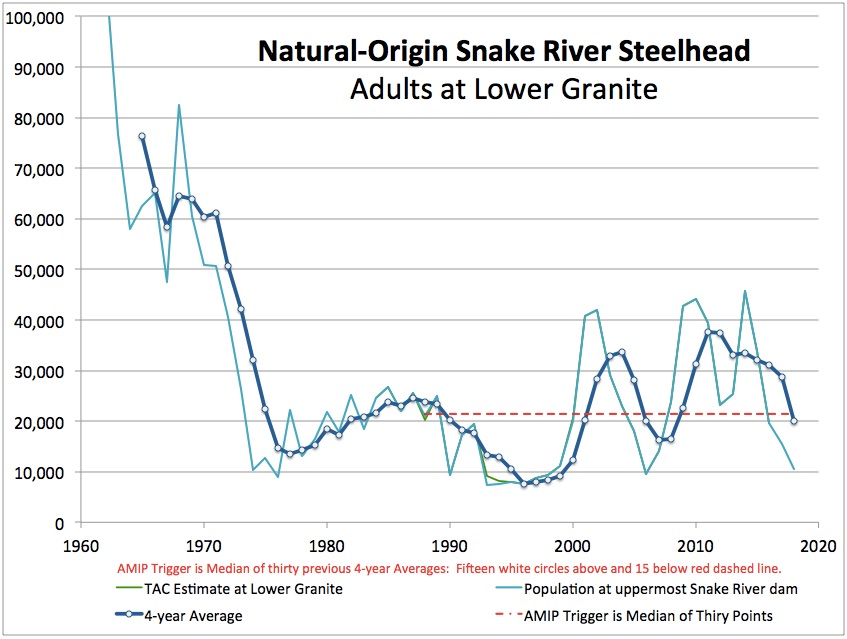 Fisheries managers in Idaho and Washington are slashing bag limits for steelhead trout in response to what is projected to be the lowest run in nearly 90 years.
Fall chinook harvest rules are changing as well to protect wild salmon from fishing impacts.
Starting Friday, Idaho's steelhead bag limits on the Snake, Salmon and Little Salmon rivers will drop from three hatchery fish per day to two. On the Clearwater River and its north, south and middle forks, the daily bag limit will remain at two hatchery fish, but starting Friday, only one of those can be 28 inches long or longer.
In Washington, the bag limit for hatchery steelhead will fall to one fish per day on both the Tucannon River and the Snake River from its mouth to Lower Granite Dam. The bag limit will drop from three fish per day to two on the Snake between Lower Granite Dam and the Washington-Oregon state line upstream of Heller Bar. Chris Donley, fish program manager for the Washington Department of Fish and Wildlife at Spokane, said the bag limit changes still need to move through the agency's process and will likely take effect later this week.
He said the moves are being made largely to protect wild fish and B-run steelhead bound for the Clearwater basin in Idaho.
"Ocean conditions for steelhead are pretty rotten, he said. "We will get through this. We've gotten through it in the past."
Both Idaho and Washington are ending harvest for wild fall chinook. But anglers can continue to fish for and keep up to three hatchery fall chinook per day in the Snake, Clearwater and lower Salmon rivers. Idaho's fall chinook change takes effect Friday. The effective date of the rule change in Washington has not been announced.
From July 1 through Monday, 52,232 steelhead were counted passing Bonneville Dam on the Columbia River. That is the lowest tally for that time span since the dam was completed in 1938. Fisheries managers now expect a total steelhead run of just 61,500 fish. They expect 53,400 A-run steelhead, including 17,500 wild fish, and 8,100 B-run steelhead, with just 2,900 wild fish. The return of wild steelhead to the Salmon River is projected to be below an abundance threshold that triggers conservation measures such as bag limit reductions.
The demise of the B-run is especially alarming. Fisheries managers had forecast a return in excess of 40,000 fish prior to the season. Even as the A-run faltered, they hoped the B-run would return in decent numbers. Over the past few weeks, an expected bump in the number of fish crossing Bonneville Dam failed to materialize.
Despite the low numbers, Joe Thiessen, regional fisheries manager for the Idaho Department of Fish and Game at Lewiston, said the runs are strong enough to support some harvest. The bag limit changes are expected to reduce participation in the fishery which will help fisheries managers meet hatchery spawning goals while also reducing pressure on wild fish.
There is room to harvest on this population, we just don't want to let it get out of hand," he said.
Fisheries managers will monitor harvest throughout the fall and make more changes if needed.
Related Pages:
A-run Steelhead Trending Below Average Return by Eric Barker, Moscow-Pullman Daily News, 8/6/26
A-run Steelhead Surpass Expectations by Eric Barker, Lewiston Tribune, 8/21/25
learn more on topics covered in the film
see the video
read the script
learn the songs
discussion forum