forum
library
tutorial
contact
Idaho Sampling Shows 77% Drop
in Snake River Quagga Mussels
by Brad Carlson
Capital Press, August 19, 2026
|
the film forum library tutorial contact |
|
Idaho Sampling Shows 77% Drop
by Brad Carlson
|
Quagga mussels were detected in the
Mid Snake near Twin Falls in September 2023
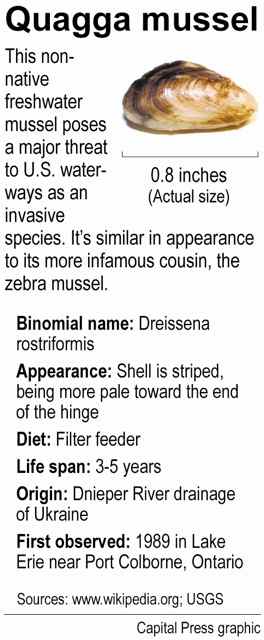 Quagga mussel detections in the Middle Snake River decreased substantially in the past year.
The Idaho State Department of Agriculture now is detecting 77% fewer veligers, or larvae, than in 2025 based on ongoing sampling, according to a news release. As the mussel population decreases, the department has increased diving efforts and other, more targeted approaches to earlier detections.
Quagga and zebra mussels can cause substantial damage to hydroelectric power, irrigation and drinking water infrastructure, and can alter aquatic environments. Mussels can move from one water body to another by clinging to boats and other equipment that is transported.
ISDA first detected quagga mussels in the Mid Snake near Twin Falls in late September 2023 during routine sampling. The agency treated the infested area with chelated copper in 2023, 2024 and last year. All treatments reduced and contained the infestation, according to the department's Invasive Species of Idaho website.
The known, contained infested area is just upriver from Twin Falls Dam downstream to Shoshone Falls, public information officer Sydney Kennedy said.
"That area of the Snake River is complex, with deep holes and cracks in rock faces and shifting flows," she said. These environments, which ISDA staff refer to as micro safe harbors, are "where we're seeing the veligers and the adult populations. But what we are seeing is a significant reduction."
Better understanding
Increased diving in known infested areas has enabled crews to better understand the mussel population, flows and safe-harbor environments, Kennedy said. Staff are working on a treatment plan for mussels in these environments.
Other factors in the year-to-year drop in detections include an aggressive treatment strategy, enhanced monitoring, and maintaining a mandatory watercraft inspection and decontamination zone, she said. The zone is from Broken Bridge to Hansen Bridge.
ISDA plans to start a multi-phase treatment process in the infested area starting in the last week of August, "taking action while the infestation remains limited," according to the release.
"We know what is at stake if invasive mussels gain a foothold in Idaho," department director Chanel Tewalt said. "Our previous treatments have proven to be effective, and this level of containment is unprecedented among known quagga mussel infestations. No other state has a proven playbook for how to accomplish this work. Idaho is charting new territory with our eradication effort."
"Other states have shown us what happens when invasive mussel infestations are allowed to establish before action is taken," Gov. Brad Little said. "Those delayed responses have resulted in significant long-term management costs coming directly out of taxpayer pockets. Idaho has set the standard by responding aggressively. Our responsible strategy on the Snake River is proving to be effective, and we will continue making decisions that give us the best opportunity to eliminate quagga mussels to protect Idaho's waters and the people who depend on them."
Similarly prolific and destructive golden mussels were detected in October 2024 in the Port of Stockton, Calif. The state was not able to initiate a full eradication program due to limiting factors, and now veligers can be found from the Sacramento to San Diego areas, according to the ISDA release.
learn more on topics covered in the film
see the video
read the script
learn the songs
discussion forum