forum
library
tutorial
contact
New Columbia River Estuary
Purchases Benefit Salmon
by Staff
Coast River Business Journal, April 3, 2012
|
the film forum library tutorial contact |
|
New Columbia River Estuary
by Staff
|
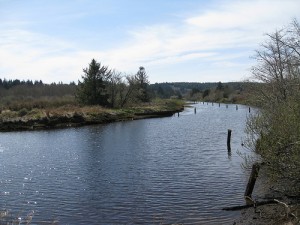 Columbia Land Trust and the Bonneville Power Administration today announced the purchase of 560 acres near the mouth of the Columbia River to permanently protect riverside habitat for Northwest fish and wildlife, including threatened and endangered salmon and steelhead.
The acquisitions will benefit young salmon and steelhead from Oregon, Washington and Idaho that gain essential strength in the estuary during their migration to the ocean.
Protecting habitat in the estuary helps offset the impacts of federal hydroelectric dams on the Columbia and Snake river systems and is a central element of a federal biological opinion governing operation of the dams.
The three newly protected properties include:
Columbia Land Trust purchased the properties with funding from the Bonneville Power Administration and its electric ratepayers. Additional funds were provided by the U.S. Fish & Wildlife Service and the Washington Recreation & Conservation Office: Salmon Recovery Funding Board. The final purchase, Knappton Cove, closed last week. BPA will receive a conservation easement for each property to ensure that their habitat will be protected in perpetuity.
"We have stepped up our efforts to protect and restore estuary habitat as science has demonstrated how important the estuary is to juvenile fish," said Lorri Bodi, BPA's vice president of Environment, Fish and Wildlife. "Good estuary habitat is like a head start program for salmon about to head out to the ocean."
Management plans for the properties will be developed with public input. Potential restoration will also support the local economy and jobs. The restored habitat will benefit coho, chinook and chum salmon; steelhead; and cutthroat trout, as well as terrestrial wildlife such as black bear, elk and river otter.
Federal agencies are responsible for mitigating the impacts of federal hydroelectric dams on salmon as outlined by NOAA Fisheries' Biological Opinion. The mitigation includes new technology ensuring more fish pass dams safely and habitat restoration, with increasing focus on the estuary below Bonneville Dam.
learn more on topics covered in the film
see the video
read the script
learn the songs
discussion forum