forum
library
tutorial
contact

Dams Aren't the Cause for Declining
Numbers of Fish in Idaho
by John McKern
Lewiston Tribune, September 6, 2026
|
the film forum library tutorial contact |
|
Dams Aren't the Cause for Declining
by John McKern
|
Authorized with three turbines and room for three more, the full complement
of six turbines was expedited at each lower Snake River dam by 1978.
 In his column recently published in the Lewiston Tribune, Travis Wendt captured economic impacts of poor salmon returns to Idaho rivers in 2026. He was right except for the cause.
As a biologist for the Army Corps of Engineers from 1971 to 2000 and a fish passage consultant from 2000 through 2025, I was involved in efforts to mitigate dam impacts to salmon and develop structures to make them safer for the salmon. I became a Corps' representative managing research contracts with the National Marine Fisheries Service, state agencies, universities and consultants.
My first assignment at the Corps was to help reduce the catastrophic total dissolved gas problem the Corps' dams caused from Idaho to the estuary. The TDG catastrophe was the top priority in the 1970s. Spillway deflectors were added at Corps' dams to reduce spilled water from plunging into the 50-foot-deep pools below spillways where TDG increased to deadly levels. Authorized with three turbines and room for three more, the full complement of six turbines was expedited at each lower Snake River dam by 1978. This allowed up to 130,000 cubic feet per second to pass through the turbines and spill of another 60,000 to 80,000 cfs at each dam without exceeding the Environmental Protection Agency and state 110% TDG water quality standards. With springtime flows ranging up to 300,000 cfs, the TDG problem was greatly reduced most years.
Concurrently, the Corps, NMFS and others developed fish screens and facilities to bypass juvenile salmon (smolts) around turbines where up to 13% mortality could occur. A 1981 report showed that smolt survival through turbines could be improved up to 93% by operating turbines at peak efficiency. Since 2020, redesigned turbines with 98% survival are replacing old ones beginning with three at Ice Harbor Dam.
The percentage of smolts screened from turbines varies by salmon type, up to 95% for steelhead, 75% to 85% for yearling spring and summer chinook and around 50% for sub-yearling fall chinook. Less is known about Snake River coho (back from extinction) and sockeye (under special management because of near extinction).
During the last five decades, millions have been spent improving bypasses at the dams. The Lower Granite juvenile fish collection system was state of the art in the 1970s, providing 98% survival. However, systems have improved and the Lower Granite facility received the last upgrade in 2020, bringing survival to 100%. Improved operations and facilities have raised bypass survival to 99% to 100% at all four dams.
In 1965, NMFS began trucking smolts collected at Ice Harbor Dam to below Bonneville Dam. As bypass facilities were developed, transportation was approved by the regional fishery agencies. Objectives were: (1) to avoid turbine mortality at downstream dams, (2) to avoid predators in downstream reservoirs, and (3) to offset smolt migration delays caused by the series of eight dams and reservoirs. Since 1976, the Corps has acquired fish transport trucks that can transport up to 17,000 smolts per trip.
When 1977 threatened to be a severe drought year, the Corps acquired two military surplus barges and modified them to transport up to 230,000 smolts at a time. Because improvements for reducing the TDG above did not cover the peak floods, a fourth objective of transport was added. New barges were equipped with dissolved gas-stripping chambers that reduce TDG levels back to normal. In the early 1980s, the Corps acquired specially two 500,000-smolt fish barges. Four more barges capable of carrying up to 750,000 smolts each later were added. Fish barge tows can leave Lower Granite Dam daily, pick up fish barges loaded at Lower Monumental and Little Goose dams, and deliver more than 1 million smolts per trip below Bonneville Dam 36 hours later. Transport has consistently provided 98% smolt survival compared to current NMFS estimates of 40% to 60% in-river survival with mass spill.
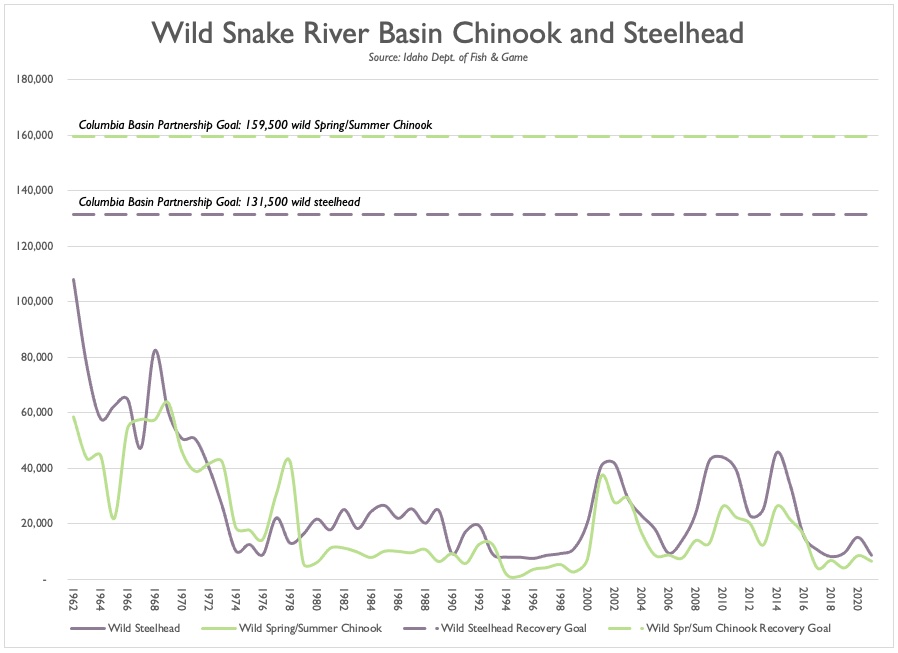 Compensation for fish losses caused by the lower Snake River dams began in the late 1970s with the Corps collaborating with the fishery agencies to develop 11 hatcheries costing about $300 million. The Snake River Basin hatcheries provide up to 25 million smolts, about half of which survive to Lower Granite Dam. The largest single 24-hour collection at Lower Granite was more than 1 million hatchery and wild smolts before mass spill.
In 2020, fishery interests convinced a federal judge to order mass spill to save the fish. The opposite has happened. Mass spill minimizes power generation and reduces smolt collection more than 90%. With the majority subject to in-river mortality, only half of the smolts now reach the ocean.
Adult returns are reduced by harvest in the ocean from Alaska to Oregon. Then salmon must swim upstream through 400 miles of river with 125% TDG and delays by confusing flows at dam fishway entrances. Adults return to hatcheries and spawning grounds with TDG trauma symptoms. Spring/summer chinook and steelhead must survive months in freshwater before spawning. Fish management agencies blame the dams for reducing smolt-to-adult returns. Ocean, lower river and Idaho river harvests are reduced or canceled because the judge and agencies require improper use of fish protective measures at the dams, not because the dams are the base cause.
Related Pages:
Dams Don't Harm Salmon Runs by John McKern, The Columbian, 5/9/25
Real Problems of Snake River Salmon by John McKern, Capital Press, 9/9/24
Proposal to Drawdown Reservoirs a Fool's Errand by John McKern, Columbia Basin Bulletin, 1/6/23
This Year's Fish Runs Show Dams Don't Need to be Breached by John McKern, Walla Walla Union-Bulletin, 10/9/22
Politicians, Environmentalists Ignoring the Facts on Snake River Dams, Salmon by John McKern, Walla Walla Union-Bulletin, 7/24/22
Turnabout Turned About by John McKern, Lewiston Tribune, 9/12/21
Say We Breach the Dams, What Then? by John McKern, Walla Walla Union-Bulletin, 7/8/21
Breaching the Dams is Not a Silver Bullet Solution by John McKern, Walla Walla Union-Bulletin, 5/19/21
Increase Wild Fish Production, Reduce Harvest by John McKern, Walla Walla Union-Bulletin, 12/23/20
Ending Super-Saturation Will Help Salmon by John McKern, Walla Walla Union-Bulletin, 4/14/19
Supersaturation is Real Trouble for Salmon by John McKern, Walla Walla Union-Bulletin, 12/27/18
Breaching Dams Won't Cool River Water by John McKern, Walla Walla Union Bulletin, 11/8/18
Blaming Snake River Dams for Orca Woes a Hoax by John McKern, Walla Walla Union-Bulletin, 8/14/18
Judge, Court of Appeals Ignored Fish Facts by John McKern, Walla Walla Union-Bulletin, 4/8/18
Ending Super-Saturation Will Help Salmon by John McKern, Walla Walla Union-Bulletin, 10/18/17
View from Idaho on Dam Protection by John McKern, Walla Walla Union-Bulletin, 8/1/17
Yes, Consider All Facts on Dam Breaching by John McKern, Walla Walla Union-Bulletin, 6/30/17
McKern Letter: Salmon Runs by John McKern, Idaho Statesman, 1/2/16
Adult Salmon Survival Past Dams is 99 Percent by John McKern, Walla Walla Union-Bulletin, 3/25/15
Hydropower Not Been Replaced by Wind Power by John McKern, Walla Walla Union-Bulletin, 3/6/15
Environmentalists Try to Muddy Waters About Dredging by John McKern, Walla Walla Union-Bulletin, 12/30/14
Talk of Breaching Snake River Dams a Red Herring by John McKern, Walla Walla Union-Bulletin, 3/21/14
Blaming Dams for Fish Loss is a Hoax by John McKern, Walla Walla Union-Bulletin, 8/23/13
Judge Redden's Replacement Can't Be Worse by John McKern, Walla Walla Union Bulletin, 12/5/11
Science Does Not Support Dam Breaching by John McKern, Walla Walla Union Bulletin, 12/19/11
learn more on topics covered in the film
see the video
read the script
learn the songs
discussion forum