forum
library
tutorial
contact

9th Circuit Questions August Spill,
Public Safety in CRSO Appeal Hearing
by K.C. Mehaffey
NW Fishletter, October 20, 2026
|
the film forum library tutorial contact |
|
9th Circuit Questions August Spill,
by K.C. Mehaffey
|
Callahan twice asked whether remanding the case back to
the District Court could change the outcome for federal agencies
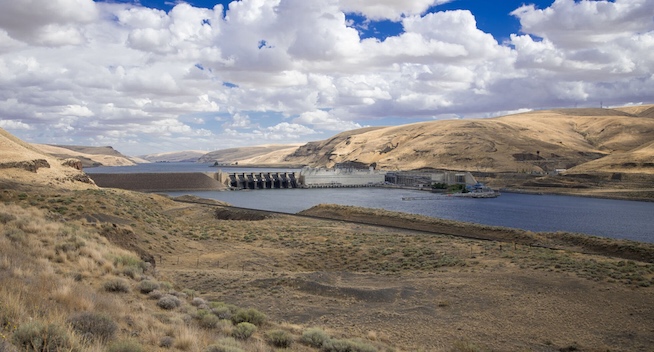 During oral arguments Oct. 20, three judges on a 9th U.S. Circuit Court of Appeals panel asked whether they could consider public safety, how to balance the needs of salmon with other needs within the Columbia River System, and why a lower court ordered more spill in August.
Attorneys for federal agencies, the Public Power Council and the Inland Ports and Navigation Group filed separate appeals over a Feb. 25 preliminary injunction in which U.S. District Judge Michael Simon ordered more spill for longer durations at eight federal dams in the lower Snake and Columbia rivers.
The appellants asked the appeals court to find Simon's reasoning flawed and to remand his order for injunctive relief back to the U.S. District Court for the District of Oregon.
Ten environmental groups represented by Earthjustice asked the appeals court to affirm Simon's injunction, which would keep it in place until Simon rules on the underlying lawsuit, in which plaintiffs claim that a 2020 biological opinion on Columbia River System Operations is inadequate.
The three judges on the panel were Judge Consuelo Callahan, appointed by President George W. Bush; Judge Kenneth Lee, appointed by President Donald Trump; and Judge David Ezra, appointed by President Ronald Reagan.
- Quick Take: On Oct. 20, lawyers representing federal agencies and 10 environmental groups underwent questioning by a 9th U.S. Circuit Court of Appeals panel of judges that will decide whether a lower court order to spill more water over dams in the Columbia River is legally valid.
- The Big Picture: The circuit court's decision will only impact the Columbia River System Operations -- which included higher spill through the end of August -- until the underlying case over the 2020 Columbia River System Operations biological opinion is decided.
- Historical context: For the past 25 years, plaintiffs have prevailed in all other 9th Circuit appeals of lower court decisions, but this time they faced a panel of judges who were all appointed by Republican presidents.
Callahan twice asked whether remanding the case back to the District Court could change the outcome for federal agencies.
"Hypothetically, if this court were to affirm the District Court on the preliminary injunction, is there any way you can win after this?" Callahan asked U.S. Department of Justice attorney Jacob Ecker.
"It certainly seems like the District Court has put a heavy thumb on the scale against that outcome," Ecker replied.
Callahan previously asked the same question to Amanda Goodin Earthjustice supervising senior attorney, who represented the 10 environmental groups which -- along with the State of Oregon -- sought the injunction.
Goodin agreed that it would be difficult for DOJ to win the case if it loses the appeal. "Your honor, they can certainly make the arguments. I don't see how those arguments could possibly get around this court's plain precedent."
During Goodin's arguments, Callahan also commented, "In looking through these 25 years of litigation, I recognize that probably if you got your wish list, you don't want any dams, but that's not going to happen here."
Goodin replied, "We have not asked this court for that."
Callahan continued, "The dams are part of the baseline and that's not going to happen, so that ship has sailed, as it were. So, given over 25 years of litigation, what needs to happen to return management and operation of the Columbia River System to the federal government?"
"The government would have to stop recycling the same legal framework that this court has already rejected in past biological opinions, and it has to actually look at the effect on the fish here, not just the legal construct where they try and just compare it to what they were doing yesterday," Goodin responded.
She said as an example, in its 2020 CRSO BiOp, the National Marine Fisheries Service estimated that the survival rate for juvenile Snake River spring-summer Chinook would be 42.8 percent under the operations spelled out in the 2020 CRSO record of decision. The estimated survival rate under the prior CRSO biological opinion -- which was found to be inadequate -- was 42.7 percent, she said.
"Talk about missing the forest for the trees -- half of the fish are dead before they reach the ocean," Goodin said. She said that the government's own modeling found that some of the most imperiled species will be gone "very, very soon," but contends that because climate change isn't their fault, the federal agencies don't have to account for that in the BiOp.
In rebuttal, Ecker said that Goodin provided an example of one page where NMFS discussed changes from past practices. He said the agencies did consider whether the proposed operations would jeopardize fish. "This is the BiOp that ought to satisfy judicial review," he said.
Lee asked whether the 9th Circuit's precedents allow the court to consider human safety when balancing significant irreparable harm to endangered species.
He noted that the Public Power Council's filings noted that August spill can come amidst heat waves, and the need for air conditioning puts more pressure on the grid. "It's not completely speculative. I mean, look at Europe. I think in Paris, what, about 10,000 people died because they didn't have air conditioning this summer," he said.
Goodin responded that the court can consider human safety. "But critically, the District Court did specifically consider impacts to the reliability of the power system," she said.
She also said that the injunction does provide off-ramps for when dam operators can reduce spill.
Lindsay Thane, attorney for the Inland Ports and Navigation Group, said those off-ramps aren't adequate or explicit enough to accommodate the safety of barge operators who have to navigate through the spill to get to each of the dam's locks. She suggested that, as in 2018, the court should require modeling of the new operations prior to issuing an injunction so that the U.S. Army Corps of Engineers understands how the spill patterns impact flows and eddies below the hydro projects.
Callahan asked Thane, "What's the importance of this spill in August, because it seems there might be an error in that?"
Thane responded that the preliminary injunction orders spill for the entirety of August, while it appeared that the court thought it was ordering the spill through Aug. 14 -- the same spill that had been agreed to in a memorandum of understanding. She said the discrepancy is in both the evidence that the District Court considered and an amendment to the order that the court wrote.
That MOU led to a stay in the litigation, but the lawsuit resumed after the Trump administration withdrew from the agreement.
Callahan also asked Goodin, "What's the basis for the District Court ordering the spill in August? That seems flat out wrong."
Goodin replied, "Respectfully, your honor, it's not." She said the District Court found that spill in late August is essential for preserving the genetic and spatial diversity of late-migrating species.
Ecker argued that operations under the 2020 decision would be better for fish than those under the preliminary injunction.
"After a quarter century of judicial intervention, it's time to return control of the Columbia River System to the federal agencies that Congress entrusted for that extremely complex task," he told the panel, adding that the agencies "reasonably concluded after years of thorough examination, struck the appropriate balance between all the competing demands on the Columbia River System all while avoiding jeopardy to any listed salmonid species."
Whether the District Court has jurisdiction to hear the case was also a topic of questioning by the judges.
Ecker said that the Bonneville Power Administration -- although it is not named as a defendant in the underlying case -- is "inextricably entwined" in the decision, and that the District Court lacks jurisdiction to hear the case because under the Northwest Power Act, any claims about BPA's decisions must be heard by the 9th Circuit (Clearing Up No. 2260).
Goodin, however, argued that BPA simply markets the power that the Corps generates at these dams.
She said BPA is not "entwined" in the case because BPA did not issue a decision that is being called into question. She said the appellees agree that under the Northwest Power Act, BPA can only be challenged in the 9th Circuit.
learn more on topics covered in the film
see the video
read the script
learn the songs
discussion forum