the film
forum
library
tutorial
contact
DONATE
|

|
Without a New Columbia River Treaty Corps Will Need to Use
'Real-Time' Flood Control, Rather Than 'Assured Storage' In Canadian Reservoirs
by Staff
Columbia Basin Bulletin, October 13, 2023
|
The U.S. does not have the additional reservoir space needed to offset
the loss of assured water storage space in Canadian Treaty reservoirs
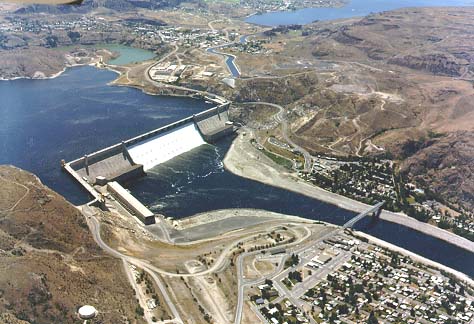 Facing the uncertainty of how it will operate the Columbia River hydroelectric system without the flood risk management controls and water storage space in Canada currently offered by the Columbia River Treaty, the U.S. Army Corps of Engineers says it may need to switch to a "real-time" operation to ensure flood control south of the Canadian border after September 2024 when the Treaty expires.
The Treaty, approved by Canada and the U.S. in 1961 and in force by 1964, will not "fully expire" in 2024, as the current Treaty will still provide for flood control operations after 2024, but it will only be in real time, said Julie Ammann, Acting Chief of Columbia Basin Water Management Division for the Corps.
That change could lead to a deeper draft of Grand Coulee Dam, the northern-most dam on the Columbia River, and the lowering of Lake Roosevelt, the reservoir backed up behind the dam.
That could expose native American artifacts, impact resident fish and disrupt ferry service on the lake, but it could also reduce the flexibility of the Columbia River's largest storage reservoir to manage water supply and runoff from Canada to protect area's downstream of Coulee from flooding.
The U.S. does not have the additional reservoir space needed to offset the loss of assured water storage space in Canadian Treaty reservoirs, the Corps said in a news release.
The Corps just completed four public information sessions where it described how it and the Bureau of Reclamation currently use reservoir space in Canada to manage river flows in the U.S. under the Columbia River Treaty and how that could change if a similar Treaty is not reached by next year.
Now, under the current 60-year-old Treaty, the U.S. has relied on "assured storage" at British Columbia dams that can store up to 8.95-million-acre feet, nearly double the storage capacity of Grand Coulee. "After 2024 there is no requirement for dedicated storage in Canada," Ammann said. "We lose the flexibility of pre-planned flood control operations."
Speakers at Tuesday morning's information session were Colonel Jeff Hall, Northwestern Division deputy commander for the U.S. Army Corps of Engineers, Ammann and Eric Rothwell, the Bureau of Reclamation's Columbia-Pacific Northwest Columbia River Coordinator.
The four virtual information sessions -- Wednesday, Sept. 27 at noon and evening, and this Tuesday, Oct. 10 in the morning and evening -- posed the question: How will the U.S. use reservoir space in Canada after Sept. 16, 2024, when it changes from the high degree of structure and control of flows coming across the border from Canada, which has been the experience over the last 60 years under the Columbia River Treaty, to an operation that increases the uncertainty of those flows?
The federal agencies operate and maintain 14 dams in the Columbia River System and continue to work as part of the U.S. team that is negotiating a modernized Treaty with Canada, a Corps news release says. If Canada and the U.S. can reach agreement to modernize the Treaty, it could reduce the uncertainty of the anticipated change after Sept. 2024, and this preplanning for the uncertainty would not be as needed. However, the two federal agencies say they will be prepared to operate regardless of the outcome of negotiations.
The U.S. has been negotiating with Canada to modernize the Columbia River Treaty since 2018. Regardless of the outcome of negotiations, federal agencies must continue operating and maintaining federal projects to meet all Congressionally authorized responsibilities. Those are flood risk management, hydropower generation, navigation, irrigation, fish and wildlife and recreation.
As the countries continue to negotiate, a major sticking point is "rebalancing" the Canadian Entitlement. The current treaty between the U.S. and Canada was signed by both countries in 1964. The agreement included key flood control protection through 2024 as well as power provisions to share in the downstream benefits of power generation on the Columbia River. That power provision is known as the Canadian Entitlement. It calls upon the U.S. to return hydropower capacity and energy to Canada for 60 years after which there would be an opportunity for the countries to discuss how to rebalance the provision based on the value to each country.
With or without a modernized agreement, the United States still has a right to access Canadian storage after September 2024, the Corps said. However, unlike the flood risk management terms in the Treaty, the post September 2024 flood risk management terms do not guarantee the United States access to pre-planned flood storage in Canada. This may result in the United States calling on Canada to manage its flooding when conditions warrant in real time.
However, while the United States can call on Canada for space during real-time operations, it is unknown how Canada will react, and it is unclear how Canada will operate its reservoirs after September 2024, the Corps said.
The change in flood risk management from guaranteed storage to real time or on call flood risk management would also likely impact the Corps' ability to balance its Congressionally authorized responsibilities, Ammann said.
For the past 60 years of the Treaty, the Corps and BOR have used the storage space in U.S. and Canadian reservoirs to manage the spring runoff from the upper Columbia River basin, the Corps says. About 30 percent of the average annual runoff is from the Canadian portion of the basin, but during large flood events that could increase to 40 percent.
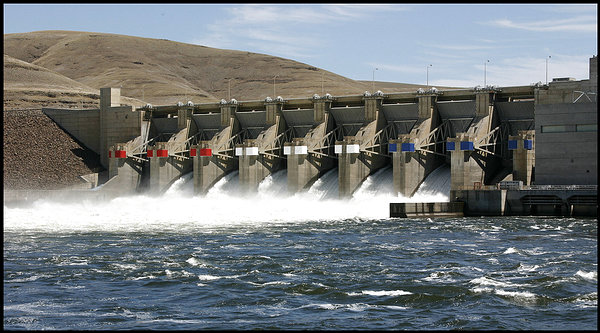 Today a little more than 20 percent of the nearly 9 million acre feet of storage in Canada is dedicated to flood risk management. After Sept. 2024, there will be no dedicated storage space to help with downstream flooding.
According to Ammann, impacts of the move away from dedicated flood risk storage in Canadian reservoirs could result in a higher chance of flooding and higher costs from the flooding, such as higher flood insurance costs, disruption of transportation, more fluctuations in water level, more water transportation disruptions in the summer due to low water, hydropower planning may need to adapt to changing streamflows, seasonal impacts to water supply, lower reservoir levels may make boat ramps unusable and the changes may impact NOAA Fisheries' biological opinion of how to operate the Columbia and Snake river dams to ensure salmon and steelhead recovery.
Before the storage dams were in place, flooding of the basin would occur regularly, according to Hall. In 1948, Grand Coulee was the only storage reservoir of any size on the Columbia River. That is also the year of the Vanport flood. Flooding wasn't just limited to the Portland area, its impacts were felt along the entire river from Canada to Astoria, OR. That's when the two countries began to talk about how to prevent such catastrophes in the future.
By 1961 when the Treaty was signed, the U.S. had added two more storage dams to its Columbia River system -- Albeni Falls and Hungry Horse dams. Later, as a result of the Treaty, the U.S. added Libby Dam and Canada added Mica, Arrow and Duncan dams, with Mica by far the largest in storage capacity.
In May, the negotiating teams for Canada and the U.S. met in British Columbia for their 17th round of negotiations. During the two-day session, the delegations discussed a range of topics, including hydropower operation planning; integrating Canada's desire for greater flexibility into treaty dam operations; incorporating input from Indigenous Nations and U.S. Tribes into treaty operations; opportunities to enhance ecosystem health and collaborate on ongoing salmon reintroduction studies; and flood-risk management in the U.S. after the treaty regime changes in September 2024 from the current assured flood-control regime to the more ad-hoc called-upon regime.
On Aug. 10 and 11, 2023, Canada and the United States held the 18th round of negotiations toward a modernized Treaty.
The U.S. delegation hosted the meeting in Seattle, welcoming the Canadian negotiating team, which included representatives of the governments of Canada and B.C., and the Ktunaxa, Secwepemc and Syilx Okanagan Nations.
Negotiators discussed various aspects of the U.S. proposal that was delivered a few weeks earlier, with Canada continuing to advocate for increased domestic flexibility in treaty dam operations to enhance Indigenous cultural values, ecosystems and socioeconomic interests, updated flood control provisions and hydroelectric benefits. Also discussed was finding common ground on bilateral treaty ecosystem provisions and efforts to reintroduce salmon into the upper Columbia River.
The Canadian negotiators say the Seattle round "was a constructive session that advanced the negotiators' thinking on the challenges and opportunities they face in integrating Canada and the United States' respective and mutual water-management objectives. Negotiators saw the two-day session as useful in developing a path forward toward an agreement-in-principle on a modernized treaty that meets both countries' interests."
In the coming weeks, they said, Canada will provide U.S. negotiators with their response to the latest American proposal. The date and location of the next round of negotiations have not been confirmed.
Related Sites:
Corps Information Sessions to Focus on Basin Power/Flood Control if No Agreement Reached on New Columbia River Treaty with Canada by Staff, Columbia Basin Bulletin 9/22/23
Staff
Without a New Columbia River Treaty Corps Will Need to Use 'Real-Time' Flood Control, Rather Than 'Assured Storage' In Canadian Reservoirs
Columbia Basin Bulletin, October 13, 2023
See what you can learn
learn more on topics covered in the film
see the video
read the script
learn the songs
discussion forum